Mechanism
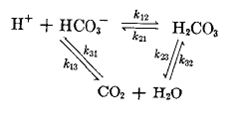
Although the hydration of carbon dioxide can occur even without the enzyme, carbonic anhydrase can increase the rate of the conversion up to a million fold. When carbon dioxide is hydrated in various buffers without CAII, the average knon was only 0.037 s -1 (12). This reaction is outlined in Figure 5.
Figure 5. Uncatalyzed hydration of carbon dioxide. The carbon dioxide must react directly with water to form carbonic acid. A hydrogen ion is then transferred from the acid to a buffer in the solution.
The effectiveness of CAII comes from the structure of its active site. Although the uncatalyzed reaction uses buffers to aid in proton diffusion, CAII also contains molecules in its active site to make this process much faster. An illustration of this active site is shown in Figure 6.
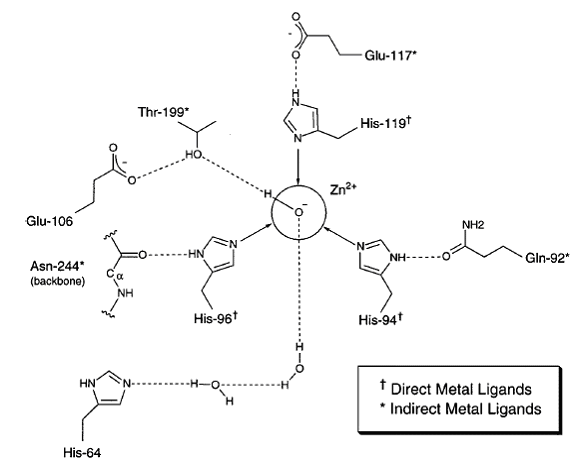
Figure 6. Scheme of active site of native CAII (13). Catalysis is dependent on the presence of the zinc ion and the histidine groups.
The active site of human carbonic anhydrase II contains a zinc ion located 15 Å deep within the cavity (13). This zinc ion is liganded by His-94, His-96, His-119, and hydroxide ion to keep it in tetrahedral coordination geometry (14). The zinc orients the hydroxyl group for nucleophilic attack on carbon dioxide molecules. The zinc-bound hydroxide is stabilized by donating a hydrogen bond to the side chain of Thr-199, which in turn donates a hydrogen bond to the carboxylate group of Glu-106 (9). This hydrogen bonding keeps the zinc center in the right configuration for catalysis.
The CAII-catalyzed CO2 hydration reaction occurs in two distinct steps, as shown in Figure 7.
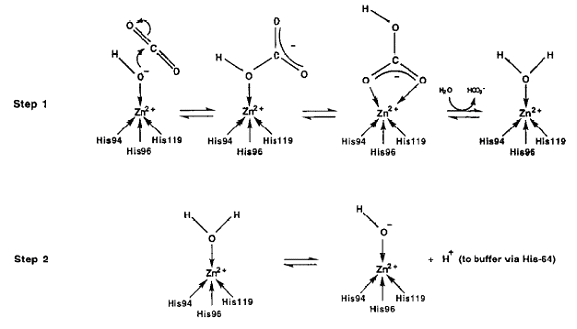
Figure 7. The mechanism of CO2 hydration catalyzed by CAII (9).
In the first step, zinc-bound hydroxide attacks the carbonyl carbon of the entering CO2 to form zinc-bound bicarbonate; bicarbonate is subsequently displaced by a ligand-exchange step with water (13). In the second step, a proton is transferred from zinc-bound water to buffer via shuttle group His-64 to regenerate the catalytically active species, zinc-bound hydroxide.
The individual rates of carbon dioxide hydration have not been well studied and although this reaction is reversible, a thorough kinetic analysis of the reverse reaction remains to be performed. The Km for carbon dioxide was found to be an average of about 4 mM (12). The kcat of CAII was found to be 1.4 x 10 6 s -1 and its second-order rate constant, kcat/ Km is 1.5 x 10 8 M -1 s -1 (15). For the reverse reaction the kcat is 4.0 x 10 5 s -1, the bicarbonate Km is 26 mM, and the kcat/Km is 1.5 x 10 7M -1 s-1 (8). Since individual rate constants for the reverse reaction have yet to be researched, the hydration of carbon dioxide will be focused on. An overview to the two parts of enzymatic CO2 hydration in Equations 1 and 2.
Equation 1:

Equation 2:

Although every individual rate constant for the enzymatic mechanism of CO2 hydration are not known, some values have been found. The proton transport step has been better researched than the hydration reaction in Equation 1. Proton transfer between zinc-bound water and His-64 proceeds with a rate constant of about 1.0 x 10 6 s -1 (15). Buffers have also been found to be important to catalysis since they are much better proton acceptors than water and much more concentrated in most kinetic studies at physiological pH than the hydroxide ion. Since this value closely resembles the value of the kcat, proton transport from the active site is a very important step for this enzyme. This makes His-64 a vital catalytic group, as it is able to shuttle protons from the active site to buffers in solution, regenerating the zinc-bound hydroxide for another reaction. This rapid proton shuttling makes CAII a very effective enzyme for carbon dioxide hydrolysis. In kinetic terms of the two step reaction, kcat is a reflection of the rate of proton transport (Equation 2), whereas the kcat/ Km is more reflective of the hydration step (Equation 1) and depends more on the binding affinity of the substrate than the rate of proton transport (3).